
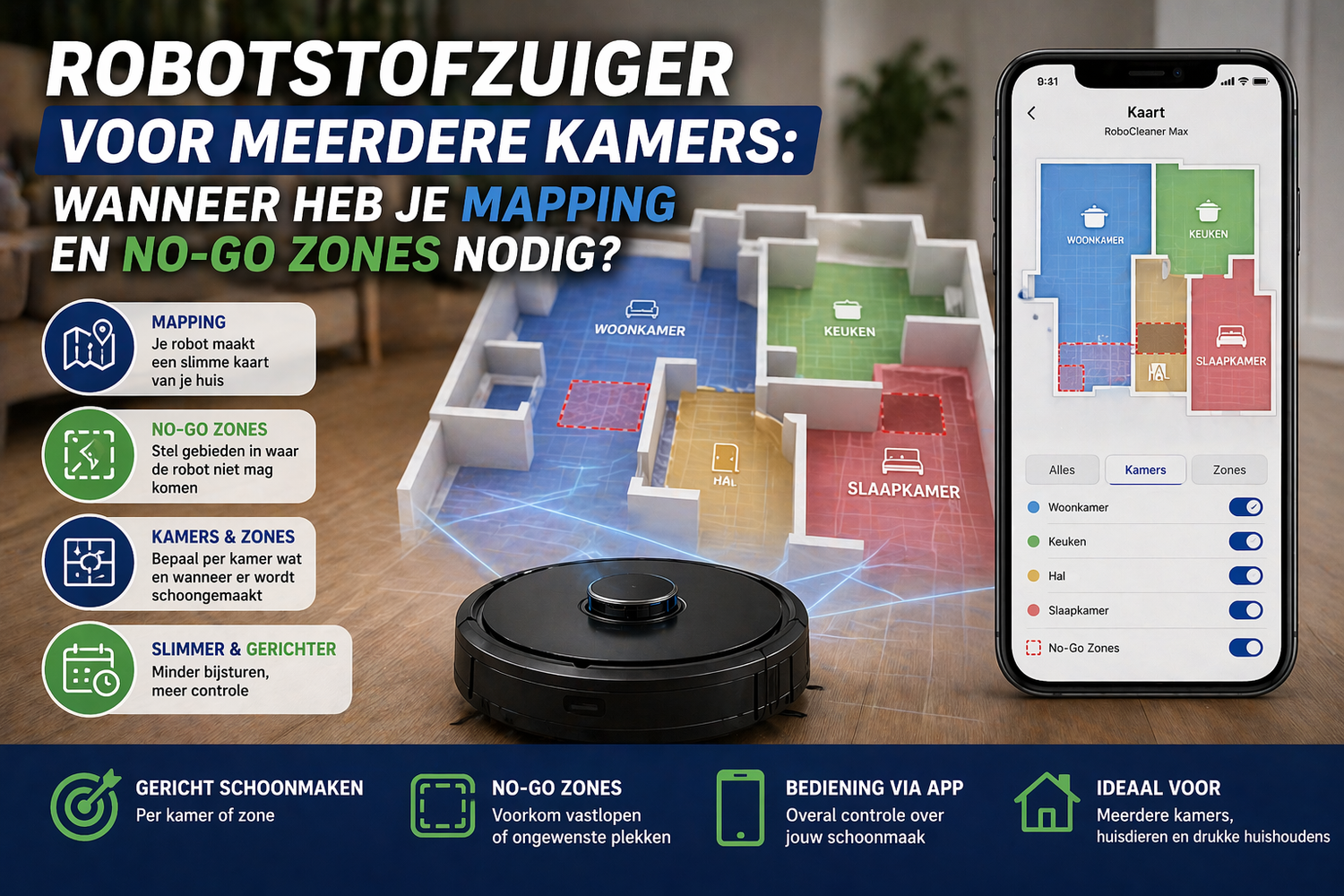
Robot vacuum cleaner for multiple rooms: when do you need mapping and no-go zones?
In a small, uncluttered home, a robot vacuum cleaner that simply makes its daily rounds is often sufficient. But as soon as your home consists of multiple rooms, you want to avoid furniture more smartly, or skip certain areas, mapping, zones, and no-go areas suddenly become much more interesting. The question, then, is not whether these features are "nice to have," but whether they truly make your household easier to manage.
What exactly is mapping?
Mapping means that a robot vacuum cleaner builds a map of your home. This allows it to better know where it has already been, which rooms exist, and how to move through your house more intelligently.
That sounds technical, but in practice, it primarily means more control and less randomness. Instead of "just starting somewhere," the robot can clean more purposefully.
What are no-go zones?
No-go zones are virtual areas that you can designate as forbidden territory in the app. This is useful if, for example, you have an area with many cables, a playmat, pet food bowls, or a corner where your robot often gets stuck.
Instead of setting up physical barriers, you manage it digitally. This makes a robot vacuum cleaner much smarter in daily use.
When do you really need these features?
1. If your home consists of multiple rooms
In an open living room, a simple robot is often fine. But in homes with separate areas like a living room, kitchen, hallway, and bedrooms, it quickly becomes useful to be able to work per room.
- More targeted cleaning per room
- Fewer illogical routes
- More control over where the robot starts or stops
2. If not every room is equally important
Some places get dirty every day, others almost never. Think of the kitchen, dining area, or hallway. In such cases, you don't want every room to be treated exactly the same, but rather to be able to prioritize more easily.
3. If you have pets or children
Food bowls, litter boxes, toy areas, or loose items on the floor make no-go zones much more useful. They prevent the robot from going into areas where you'd rather it didn't.
4. If you have a lot of furniture, cables, or tricky corners
The more cluttered a home is, the more you benefit from a robot that navigates smarter. Especially if you don't want to "robot-proof" half the house before each cleaning cycle.
5. If you want to spend less time on readjustments
A robot vacuum cleaner is supposed to save you work. If you constantly have to move it, restart it, or correct where it does and doesn't go, that benefit quickly disappears.
When do you NOT really need mapping?
Small and simple homes
Do you live in a studio, small apartment, or an uncluttered home with few obstacles? Then a simpler model can often be more than enough.
If you primarily seek basic convenience
Not everyone wants to set up rooms, draw zones, and manage everything in an app. Sometimes you just want a clean floor daily without too many settings. In that case, simplicity is an advantage.
If you have few problem areas
Do you not have pet food bowls, loose cable zones, playmats, or other tricky areas? Then you often won't miss no-go zones as quickly either.
What is the biggest practical advantage?
For most people, the biggest advantage isn't even in the technology itself, but in the feeling of control. You can much better determine where, when, and how the robot cleans.
This makes a particular difference in homes where one room needs daily attention and another hardly any. In such cases, a robot vacuum cleaner doesn't just become a tool, but truly a smart part of your household.
Common purchase mistake
Many people think that mapping and no-go zones are only interesting for tech enthusiasts. But that's not true. These features are most valuable for people who want less hassle, not more.
So the real question isn't: "Do I want an advanced robot?" The real question is: "Do I want a robot that better fits the layout of my home?"
When is a simpler model still the best choice?
A simpler robot vacuum cleaner remains a smart choice if you:
- have a smaller or uncluttered home
- primarily want to keep up with daily dust, crumbs, and hair
- don't need an elaborate room layout
- value price-quality more than maximum control
In that case, you often benefit more from a practical robot that's easy to use, rather than features you'll hardly ever use.
Why the choice between RoboCleaner 1400 and RoboCleaner Max becomes clear here
Precisely on this topic, the difference between the two STEGA models becomes clear.
RoboCleaner 1400 is a good fit if you…
- are looking for an affordable robot vacuum cleaner
- have a smaller or normal-sized home
- primarily want daily maintenance
- don't need extensive zones or room settings
RoboCleaner Max is a better fit if you…
- want to clean multiple rooms specifically
- find no-go zones useful
- want more control per room
- value smarter navigation and map building
- want less manual intervention
Why the RoboCleaner Max excels here
The STEGA RoboCleaner Max is particularly interesting for households where a robot vacuum cleaner shouldn't just "do its rounds," but truly work smarter with the home's layout. With zones, rooms, no-go areas, and map storage via the app, this model is designed for more control and less guesswork.
For whom this is especially smart
- family homes with multiple rooms
- households with pets or children
- people who want to clean specifically per room
- users who want more convenience and less intervention
Are you looking for a simpler and more affordable option for daily maintenance? Then the RoboCleaner 1400 remains a logical choice for many households.
Summary
Mapping and no-go zones are especially smart if you:
- have multiple rooms
- have different cleaning needs per room
- want to exclude problem areas
- want more control and less manual work
Do you have a smaller, simpler home? Then a basic robot is often enough. Do you have a busier home and want to clean smarter per room? Then a model with mapping and no-go zones is often the better investment.

Leave a comment
This site is protected by hCaptcha and the hCaptcha Privacy Policy and Terms of Service apply.